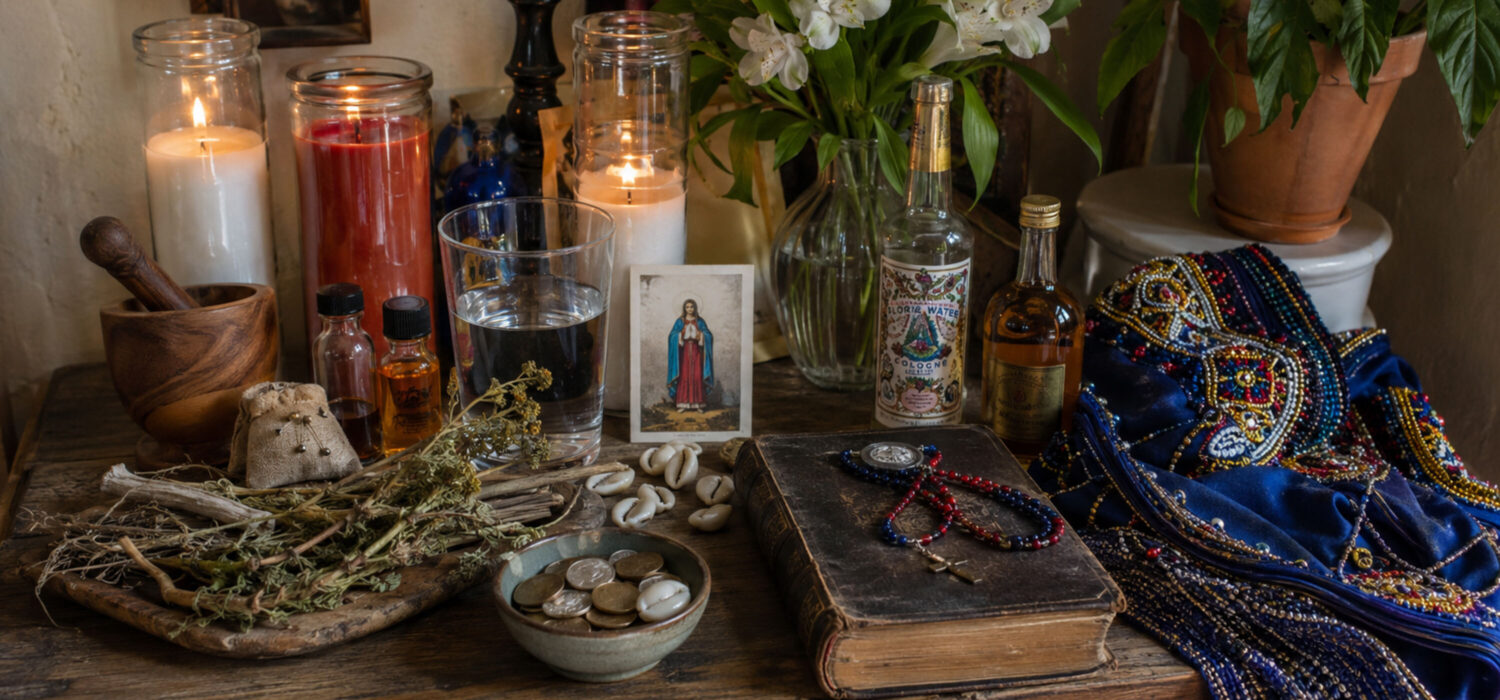
Hoodoo vs. Voodoo: What's the Real Difference?
Say the word Hoodoo, and someone will nod and think of Voodoo. Say Voodoo, and the same thing happens in reverse. The names sound alike, and popular culture blurs them further. But Hoodoo and Voodoo come from different histories. They serve different purposes. They are not interchangeable, though people often treat them that way.
Getting this right matters. Both traditions carry real weight for the communities who practice them. Understanding what actually separates them is the first step toward approaching either one with respect.
Hoodoo: What It Is
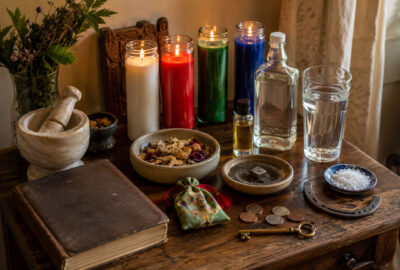
Hoodoo, also called rootwork, is a folk magical tradition. It developed among Black Americans in the Southern United States. It draws on West African spiritual knowledge, reshaped by enslaved and free Black people who worked with whatever roots, herbs, and materials the land gave them.
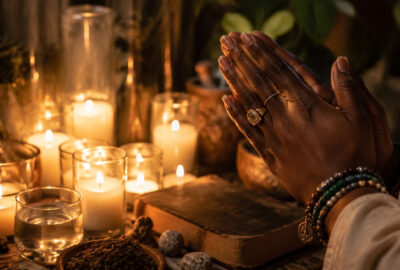
Hoodoo is a practice, not a religion. It has no shared clergy, no central cosmology, and no required rituals of initiation. A rootworker's power comes from skill, personal will, and a deep knowledge of the plants and curios they work with. Many rootworkers are Protestant Christians who fold prayer and scripture directly into their conjure work, though the tradition itself asks for no particular faith.
Our full beginner's guide to Hoodoo rootwork covers this tradition in depth. It walks through its core beliefs, its roots and curios, and how to begin practicing with respect.
Voodoo (Vodou): What It Is
Voodoo, more accurately spelled Vodou in its Haitian form, is something different altogether. It is an organized religion, not a folk practice. It has its own priesthood, its own ceremonies, and its own cosmology built around a pantheon of spirits called the Lwa.
Vodou traces back to the Vodun religions of West Africa, particularly among the Fon and Ewe peoples. Enslaved Africans carried this religion to Haiti. There it merged with Catholic imagery and Indigenous Taino elements to become Haitian Vodou. A related tradition, Louisiana Voodoo, developed separately in New Orleans, shaped by its own mix of African, Catholic, and Indigenous influences.
Initiation matters deeply in Vodou. Priests and priestesses, called Houngans and Mambos, undergo structured training before they can lead ceremonies. They serve the Lwa on behalf of a whole community. This is not a tradition built for casual solo practice the way Hoodoo often is.
Haitian Vodou and Louisiana Voodoo: Two Distinct Traditions
The word Voodoo actually covers two related but separate traditions, and conflating them is one of the more common mistakes people make.
Haitian Vodou is the original, fully formed religion described above. It carries its complete theological structure everywhere it's practiced, whether in Haiti itself or among Haitian communities abroad.
Louisiana Voodoo developed separately in and around New Orleans. It grew from a mix of Haitian influence, West African tradition, French and Spanish Catholicism, and Indigenous practice, all shaped by Louisiana's particular colonial history. Marie Laveau, the famous Voodoo Queen of New Orleans, became the tradition's most recognized historical figure in the nineteenth century. Louisiana Voodoo shares Vodou's use of spirits and ceremony, but its specific practices, its history, and its cultural context set it apart as its own distinct tradition rather than a simple copy of the Haitian original.
The Lwa: Vodou's Spirit Pantheon
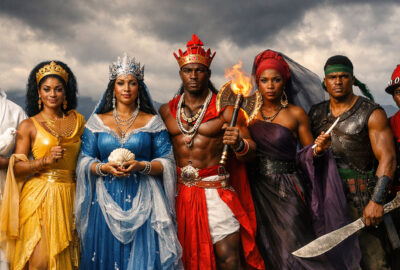
Understanding Vodou means understanding the Lwa, the spirits who sit at the center of its cosmology. Each Lwa governs a specific domain of life and is honored through distinct offerings, colors, songs, and ceremonies.
Papa Legba stands at the crossroads between the human world and the spirit world. No ceremony begins without honoring him first, since he opens the gate for every other spirit to enter.
Erzulie represents love, beauty, and femininity, though she appears in several forms with very different personalities and demands. Erzulie Freda embodies romance, luxury, and elegance. Erzulie Dantor, by contrast, is a fierce protector of women and children, associated with sacrifice and unwavering loyalty. The two faces of Erzulie show how a single Lwa can hold contradictions that a simpler pantheon might separate into different spirits entirely.
Baron Samedi presides over death and the cemetery, a guardian of the boundary between the living and the dead. He is often depicted in a top hat and dark glasses, equal parts fearsome and humorous, since Vodou treats death with both reverence and dark wit. Our guide to Baron del Cementerio explores this Lwa's role in more depth.
Damballa, an ancient serpent spirit, represents wisdom, creation, and the divine order underlying the world. He is one of the oldest Lwa, tied closely to the earliest Vodun traditions carried from West Africa. Ogou governs war, iron, and political power, honored by those who need strength and protection in conflict or ambition.
Each Lwa has preferred colors, foods, drinks, and days of the week associated with their worship, all passed down through oral tradition and formal initiation rather than written into any single central text. Practitioners communicate with the Lwa through veves, the intricate ground drawings used to invite a specific spirit into ceremony. Our guide to Vodou veves covers these sacred symbols and how they function in practice.
What Hoodoo and Voodoo Have in Common
For all their differences, Hoodoo and Voodoo share real common ground. Both trace back to West African spiritual knowledge, carried across the Atlantic during the transatlantic slave trade. Both survived by adapting, absorbing new influences without losing their core purpose.
Both traditions honor ancestors as active, present forces rather than distant memories. Both blend African spiritual practice with Catholic or Christian imagery, a survival strategy that let enslaved practitioners keep their traditions alive under forced conversion. Both use herbs, roots, and natural materials as genuine sources of spiritual power, not just symbolic props.
Both traditions have also survived centuries of misrepresentation, dismissal, and outright suppression, only to endure and grow through the resilience of the communities who kept them alive. That shared survival is worth remembering. It's easy to focus only on what separates Hoodoo and Voodoo. The deeper truth is that both come from the same well of resilience, even if what grew from that well looks different in each case.
The Core Difference: Practice vs. Religion
This is the distinction that matters most. Hoodoo is a magical practice a person can learn and apply on their own. Voodoo, in its Haitian form, is a full religion with its own clergy, theology, and communal structure.
Think of it this way. Hoodoo is closer to a skill set, like herbalism or folk medicine, that sits alongside whatever faith a person already holds. Vodou is closer to Catholicism or Santería. It is a complete religious system with its own spirits, its own priesthood, and its own path of initiation.
Ceremony and Ritual: How the Two Traditions Actually Work
Nowhere is the practice-versus-religion divide clearer than in how each tradition actually operates day-to-day.
Hoodoo work is typically solitary. A rootworker gathers ingredients, sets an intention, and performs a working alone or with a client, often at home. There is no requirement for a congregation, a temple, or a witnessing community.
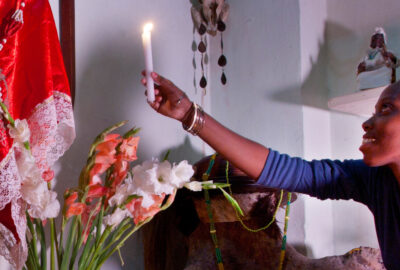
Vodou ceremony works differently. A service unfolds in a temple called a peristyle, led by a Houngan or Mambo, and draws in a full community of participants. Drumming calls the Lwa. Dancers move to specific rhythms tied to specific spirits. Possession, when a Lwa is believed to temporarily inhabit a devotee's body to speak or act, is a recognized and central part of Vodou ceremony in a way that has no real Hoodoo equivalent.
Spirits, Saints, and Syncretism
Both traditions absorbed Catholic imagery, but they use it differently. In Vodou, the Lwa are often paired with specific Catholic saints. This practice let enslaved practitioners honor their spirits under the cover of Catholic worship. Papa Legba might be represented by Saint Peter, for instance, since both are seen as guardians of the crossroads.
Hoodoo works with saints too, but more loosely. A rootworker might petition a saint for help with a working, the same way they might petition an ancestor. That saint does not belong to any fixed spiritual hierarchy. There is no equivalent to the Lwa in Hoodoo, no structured spirit pantheon a practitioner is initiated into serving.
How the Two Traditions Became Confused
The blurring of Hoodoo and Voodoo isn't an accident of casual conversation. It has real historical roots.
Nineteenth and twentieth century American writers, often outsiders looking in on Black spiritual life, applied the word Voodoo broadly to almost any African diasporic practice they didn't understand, Hoodoo included. Hollywood deepened the confusion through the twentieth century, drawing on both traditions to build a single sensationalized, fictional version, complete with zombies, curses, and pins in dolls, that resembles neither Hoodoo nor Vodou as they are actually practiced.
That fictional version is what most people picture today. The real traditions, with their own histories, structures, and depth, rarely get the same airtime.
This confusion carries real consequences. Vodou is a living religion practiced by millions of people, most of them in Haiti, with a full theological structure many outsiders never bother to learn. Reducing it to a caricature of curses and dolls strips away that depth and dignity. Hoodoo faces a related problem, often getting swept into the same caricature despite being a distinct tradition with its own separate history rooted in the American South rather than the Caribbean.
Approaching Either Tradition with Respect
If you feel drawn to either Hoodoo or Voodoo, the path forward looks different depending on which one calls to you.
Hoodoo welcomes self-directed learning. A newcomer can begin studying roots, herbs, and their traditional uses, working slowly and respectfully toward their own practice. Our beginner's guide to Hoodoo rootwork offers a starting point for exactly that kind of respectful entry.
Vodou asks for something different. Because it is a full religion with its own priesthood, meaningful practice requires connection to a Houngan, a Mambo, or an established Vodou community, not solo study from books or articles alone. Approaching Vodou with respect means recognizing it as a living faith tradition with real practitioners, real temples, and real spiritual authority, not a costume or an aesthetic to borrow from popular culture.
Whichever tradition draws your interest, the same principle applies. Learn its actual history. Understand what it asks of its practitioners. Approach it as the people who built and carried it would want it approached, with curiosity, humility, and care.
Voodoo Dolls: A Common Misconception
Few symbols carry more misinformation than the Voodoo doll. Popular culture treats it as the tradition's central tool, a way to curse an enemy with a pin. In reality, doll magic plays a minor role in actual Vodou practice. Where it does exist, it's often used for healing and blessing rather than harm.
The doll imagery most people picture actually has closer roots in European poppet magic than in West African or Haitian tradition. If you're curious how doll work is genuinely used across different folk magic traditions, our guide on how to use Voodoo dolls separates the real practice from the myth.
Frequently Asked Questions
Is Hoodoo the same as Voodoo?
No. Hoodoo is a folk magical practice from the American South. Voodoo, more properly called Vodou, is an organized religion from Haiti with its own priesthood and spirits. They share African roots but developed into very different traditions.
What's the difference between Voodoo and Vodou?
Vodou is the more accurate spelling for the Haitian religion itself. Voodoo is the common English spelling, often used loosely and sometimes inaccurately in popular culture to describe anything from Haitian Vodou to Louisiana Voodoo to Hollywood fiction.
What are the different types of Voodoo?
The two major forms are Haitian Vodou, the original organized religion with its full priesthood and theology, and Louisiana Voodoo. Louisiana Voodoo is a related but distinct tradition that developed in New Orleans from a mix of Haitian, West African, and Catholic influences.
Does Hoodoo or Voodoo involve Christianity?
Both traditions absorbed Christian, mostly Catholic, imagery through history. Vodou pairs its Lwa with specific Catholic saints. Hoodoo, meanwhile, is deeply woven into Black Protestant Christian life, with many rootworkers treating the Bible itself as a source of spiritual power. If you want to go deeper on this question for Hoodoo specifically, our guide on whether Hoodoo is evil, demonic, or a sin covers it directly.
Can anyone practice Hoodoo or Voodoo?
The two traditions differ sharply here. Hoodoo has historically welcomed personal, self-taught practice. Vodou requires initiation through a recognized priest or priestess to practice at any depth. Our guide on whether Hoodoo is a closed practice covers this distinction for Hoodoo in full.
Do Hoodoo and Voodoo have the same origins?
Both trace back to West African spiritual traditions carried across the Atlantic during the slave trade. From that shared root, Hoodoo grew into a folk magical practice in the American South, while Vodou developed into a full religion in Haiti. The shared origin explains their similarities. The different paths they took afterward explain why they look so different today.
Hoodoo and Voodoo carry different histories, different structures, and different demands on the people who practice them. Neither deserves to be flattened into the other. Learn them for what they actually are, and both traditions become easier to approach with the respect they have always asked for.