Oba: The Orisha of Loyal Love and the Power of Self-Worth
There are Orishas who govern thunder. Orishas who rule the ocean, the forest, and the crossroads. And then there is Oba, who governs something quieter and far more dangerous: the human heart in the grip of love it cannot control.
Oba, known in Lucumí tradition as Obba Nani, is the Orisha of marriage, loyalty, and the sacred dignity of commitment. She presides over the rivers that bear her name, and over every person who has ever given more than they received, sacrificed more than was wise, or loved someone who could not fully love them back. Her story is not a comfortable one. But it is one of the most honest in the entire Yoruba tradition.
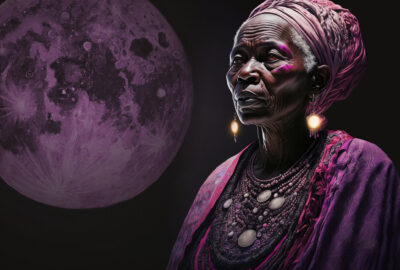
She is not widely known outside initiated circles the way Oshun or Yemaya are. But those who find their way to her tend to need her deeply. She meets them exactly where they are.
Oba and Shango: A Story of Love and Betrayal
To understand Oba, you have to understand Shango, the Orisha of thunder, fire, and overwhelming masculine energy. Shango takes three wives in the Yoruba oral tradition: Oya, Oshun, and Oba. Each one loves him. Each one suffers for it in her own way.
Of the three, Oba loves Shango with the most complete devotion. She is faithful, steadfast, and utterly committed. But Shango, drawn to Oshun's sweetness and Oya's fire, never gives Oba the attention she craves. She watches him lavish affection on the others while she tends to his home and waits.
Desperate, she goes to Oshun and asks for her secret. What does Oshun do to hold Shango's love so completely? Oshun, whose nature contains both sweetness and cunning, tells her a lie. She says she cuts off a piece of her own ear and cooks it into Shango's food, and that this is why he cannot resist her. Oba believes her. She cuts off her own ear and serves it to Shango in a meal, hoping it will bind him to her forever.
When Shango discovers what is in the food, he is horrified. He rejects Oba, and she flees in grief and shame, transforming into the river that still carries her name.
The story does not end in triumph for Oba. That is precisely why she matters.
What Oba's Story Actually Teaches
It would be easy to read this myth as a tragedy and nothing more. But Yoruba oral tradition does not preserve stories simply to record sorrow. Every story is a teaching.
Oba's story teaches that love becomes self-destruction when it abandons self-respect. She did not lose Shango because she was unworthy. She lost herself because she believed the lie that she had to mutilate her own wholeness to be loved. That is the wound Oba carries. And that is the wound she helps her devotees heal.
She is the Orisha you call on when you have given too much and received too little, when you have shrunk yourself to fit someone else's comfort, when betrayal has left you wondering whether you were ever enough.
Oshun governs the sweetness of love. Oya governs its storms. Oba governs its deepest wound, and its deepest lesson. That you cannot pour from a vessel you have emptied. That devotion without self-respect is not love. It is a sacrifice the beloved never asked for and cannot honor.
Oba's Domain and Attributes
Oba (Obba Nani) governs marriage, fidelity, domestic life, and the emotional labor that holds relationships together. She is also the Orisha of turbulent rivers, reflecting the emotional intensity of her story and her nature.
Her colors are pink, burgundy, and brown. Pink for the tenderness of love, burgundy for its depth and sacrifice, brown for the grounding that comes when you finally plant your feet on solid earth and refuse to be moved again.
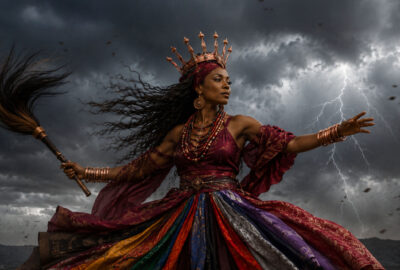
Her sacred number is 8. Her symbols include the river, the covered ear, and the machete she carries as a warrior, because Oba is not only a wounded lover. In many lineages, she is also a fierce fighter, a woman who reclaimed her power and does not hesitate to defend what is sacred.
She is honored alongside the other wives of Shango, and the dynamic between Oba, Oshun, and Oya is a complete spiritual teaching on its own. The relationship between Shango and Oya reflects passion and partnership. The relationship between Oba and Oshun reflects rivalry and the danger of measuring your own worth through comparison.
Preparing to Work with Oba
Oba rewards sincerity above all else. Before beginning any work with her, spend time in honest self-reflection. Not self-criticism. Honest inventory. Ask yourself what you have been giving that has not been honored. What you have been sacrificing that no one requested. Where you have been performing devotion rather than living it.
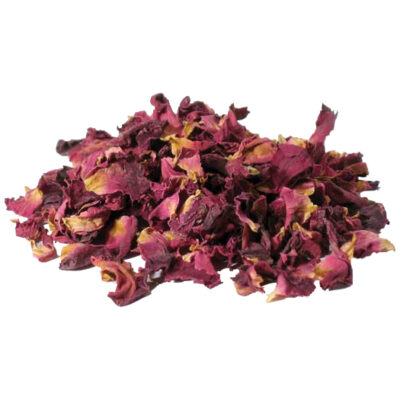
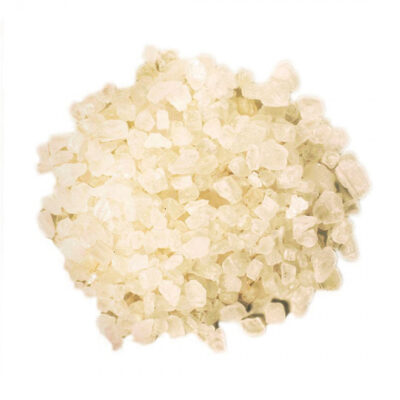
Cleanse your space and yourself before you begin. River water is ideal if you have access to it. A spiritual bath with rose petals, pink salt, and a few drops of rose oil will open you to her energy and soften the emotional heaviness this work can bring up.
Her altar space should feel intimate and honest. No performance. A simple pink or burgundy cloth, a glass of fresh water, flowers, and a candle are enough to begin.
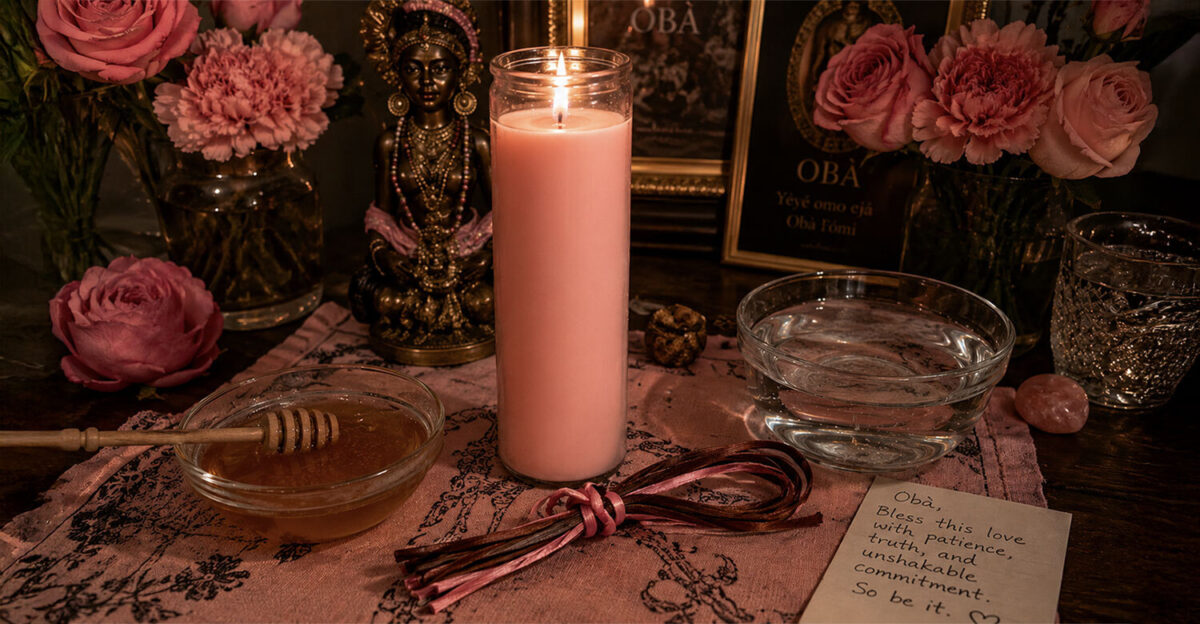
An altar dedicated to Oba, honoring love, loyalty, and lasting commitment.
Ritual for Healing from Betrayal
Oba understands betrayal from the inside. She does not require you to have it all together before you come to her. This ritual is for those who are still in the rawness of being deceived, dismissed, or discarded by someone they loved.
Gather the following ingredients before beginning:
- A pink 7 Day candle
- River water or clean water in a bowl
- Rose petals, fresh or dried
- A small piece of paper and a pen
- Sea salt
- A pink or burgundy altar cloth
Place the cloth on your altar space and set the bowl of water at the center. Scatter rose petals across the surface of the water and add three pinches of salt. Place the candle behind the bowl and set your space with intention, touching the rim of the bowl and speaking her name quietly as you do.
On the piece of paper, write the name of what hurt you. Not the person necessarily, but the wound itself. Write: the lie, the betrayal, the moment you realized you had given yourself away for something that was never real. Fold the paper three times, away from your body.
Light the candle. Hold the folded paper over the bowl without letting it touch the water. Speak aloud, in your own words, what you are releasing. Then place the paper beneath the bowl, under the cloth, where it will sit until the candle burns through.
As the candle burns, speak this prayer:
Oba, mother of faithful love,
I come to you with an open wound and an honest heart.
Help me see where I lost myself.
Help me grieve what was never honored.
And when the grieving is done,
Help me find my way back to the dignity I was born with.
I release what diminished me.
I reclaim what is mine.
Allow the candle to burn completely over the following days. Each morning, take a moment at the altar and speak one true thing about your own worth. Not affirmations. True things you actually believe. Let her work quietly beneath the surface.
When the candle is finished, take the paper to moving water if possible and release it. Thank Oba for her witness.
Ritual for Strengthening Commitment in a Relationship
Not all who come to Oba are healing from loss. Some come to her to deepen a bond that is already good, to reinforce the foundation of a committed relationship with spiritual intention and honest devotion.
This ritual is best performed on a Friday, a day traditionally associated with love and feminine energy. You will need the following components to perform this ritual:
- A pink 7 Day candle
- Honey
- Two intertwined lengths of pink and brown cord or ribbon
- Fresh flowers, particularly roses or carnations
- A small bowl of river water or clean water
Prepare your space with the cloth, the flowers, and the bowl of water at the center. Tie the two cords together in a single knot, speaking both names, yours and your partner's, as you tie it. Place the knotted cord beside the candle.
Anoint the candle lightly with honey, drawing from the base upward to draw good things toward the relationship rather than push them away. As you do, hold in your mind the specific quality you want to strengthen. Not a general wish. A specific truth. Patience. Honesty. Tenderness after conflict.
Light the candle and speak to Oba directly:
Oba, you know what it costs to love with a whole heart.
I come to you not in desperation but in devotion,
Asking that you bless this bond with the kind of love that honors both people equally.
Let there be loyalty without loss of self.
Commitment without sacrifice of dignity.
And let what we build together be worthy of what we have each given.
Let the candle burn each day until complete. Keep the knotted cord on the altar while it burns, then keep it somewhere private, a drawer, a jewelry box, anywhere it will not be disturbed.
Everyday Ways to Honor Oba
Oba does not require an elaborate ceremony to stay present in your life. She is honored in the small daily acts of self-respect that her own story lacked.
Setting a boundary you have been afraid to set. Receiving a compliment without deflecting it. Choosing your own peace over someone else's comfort. Leaving a dynamic that requires you to diminish yourself. These are all offerings to Oba.
Keep fresh flowers near water in her honor. Return to moving water when emotions feel heavy. The candle color meanings associated with pink and burgundy can guide you in smaller daily rituals when a full ceremony is not possible.
And when love feels complicated, when you find yourself wondering whether you are asking for too much or giving too much, come back to her story. Not to the wound in it. To the lesson. You were not made to cut pieces of yourself away to be worthy of love. You were already enough before you ever tried to prove it.
FAQs About Orisha Oba
Who is Oba in Santería?
Oba, also known as Obba Nani in Lucumí tradition, is one of the wives of Shango and the Orisha of marriage, loyalty, and the turbulent rivers. In Santería, she is associated with domestic life, fidelity, and the spiritual lessons that come through heartbreak and sacrifice in love.
What are Oba's colors?
Her primary colors are pink, burgundy, and brown, representing tender love, deep sacrifice, and earthly grounding.
How is Oba related to Oshun and Oya?
All three are wives of Shango in the Yoruba oral tradition. Oshun is the Orisha of sweet water, love, and sensuality. Oya governs storms, winds, and transformation. Oba governs commitment and the lessons that come through betrayal and wounded devotion. The three form a complete picture of love's many faces.
What offerings does Oba accept?
River water, pink and burgundy flowers, honey, sweet cakes, wine, and prayers spoken from an honest heart. She values sincerity above ceremony.
Can men work with Oba?
Absolutely. Oba's teachings on self-worth, betrayal, and the dignity of commitment belong to everyone regardless of gender.
Is Oba part of the Seven African Powers?
She is not among the Seven African Powers, but she is a significant Orisha in her own right, particularly within the cluster of Orishas connected to Shango.
Oba carries her wound openly, and that is her greatest gift to us. She does not pretend the hurt was small or that the lesson was easy. She simply shows us that a person can survive having their devotion taken for granted, can survive even their own desperate choices, and can rise from those turbulent waters with something the loss could never take away. She rose. She always rises. And so can you.