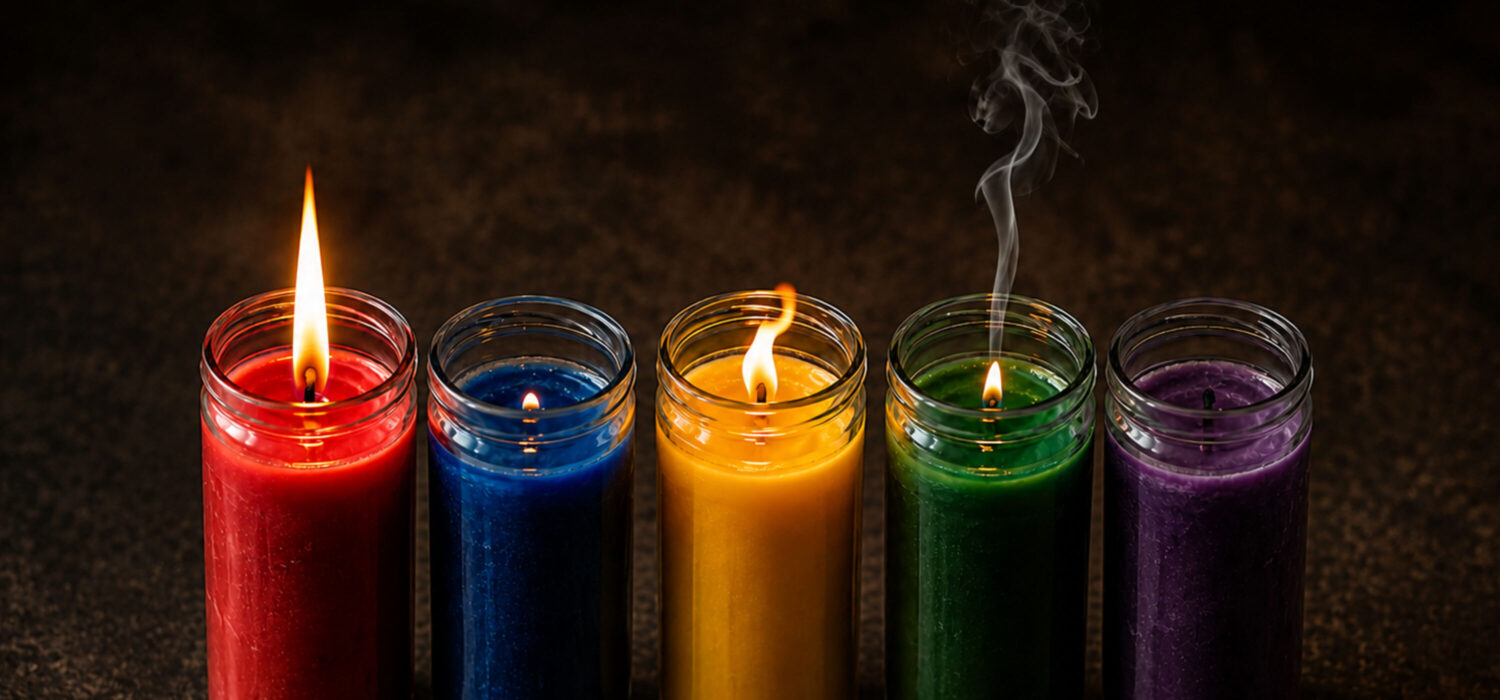
Candle Flame Meanings: A Complete Guide to Reading and Interpreting Your Ritual Candle
You light the match. The wick catches, and for a moment you just watch, the way you would watch someone's face for a sign of what they are about to say. That flame is not decoration. It is a conversation.
Across generations of Santería, Hoodoo, Espiritismo, and folk Catholic practice, a lit candle has always done double duty. It carries a prayer or a working out into the world, and it carries something back. The way it burns, how tall it stands, whether it dances or holds still, whether it splits or gutters or refuses to catch at all, these are signs. Practitioners have been reading them for as long as candles have been lit with intention.
This guide walks through what those signs mean, attribute by attribute, so you can look at your own candle and understand what it is telling you. Whether you lit a vigil candle for a saint, an Orisha candle for guidance, or a simple white candle for clarity, the flame in front of you is speaking. Here is how to listen.
The Cultural and Spiritual Roots of Candle Flame Reading
Candle reading is not one tradition. It is several, burning side by side.
In Santería and other Yoruba-derived practices, fire is one of the most direct ways to communicate with the Orishas and with Olodumarre. A candle lit for Elegua, Yemaya, or Shango is understood to carry a message in both directions, and its behavior while it burns is read as part of that exchange. Working with an Orisha candle as an individual, respectful practitioner is valid and meaningful, though deeper devotional work is best guided by an initiated priest or priestess who can read the fuller picture.
In Hoodoo and rootwork, candle work sits alongside jar spells, mojo bags, and petition papers as one of the most common tools in a practitioner's kit. Reading how a candle burns after a working is considered a basic, essential skill, passed down the same way a recipe or a remedy would be.
In Espiritismo and folk Catholic vigil practice, a candle lit for a saint, a spirit guide, or a departed loved one is treated as an open line. The flame's behavior is read as feedback from whoever the candle was lit for, whether that is San Miguel, a spirit guide, or a family member who has passed on.
None of these traditions agree on every detail, and that is worth honoring rather than smoothing over. What they share is the belief that fire does not burn blindly. It responds.
How to Read a Candle the Right Way
Reading a candle well starts before the flame ever moves. Set your candle somewhere it will not be disturbed by drafts, fans, or foot traffic, since a flame reacting to wind is not the same as a flame reacting to your prayer. A windowsill that catches a breeze or a spot near an air vent will give you false signs no matter how carefully you read them.
Check on your candle at a few natural points rather than staring at it the entire time it burns. Right after lighting, partway through, and at the moment it finishes are usually enough to catch the meaningful signs without wearing down your own patience. Vigil candles like a 7 Day Plain Candles, an Orisha Candles, or Saint and Prayer Candles are all read the same way, regardless of who or what the candle was lit for.
Keep a small dish of sand or water nearby in case a candle needs to be snuffed quickly, and never leave an open flame burning unattended in a home with children, pets, or drafts. Safety and reverence are not in conflict. A madrina who has kept candles lit for decades will tell you the same thing twice: watch closely, and watch safely.
Candle Flame Height: What a Tall or Low Flame Means
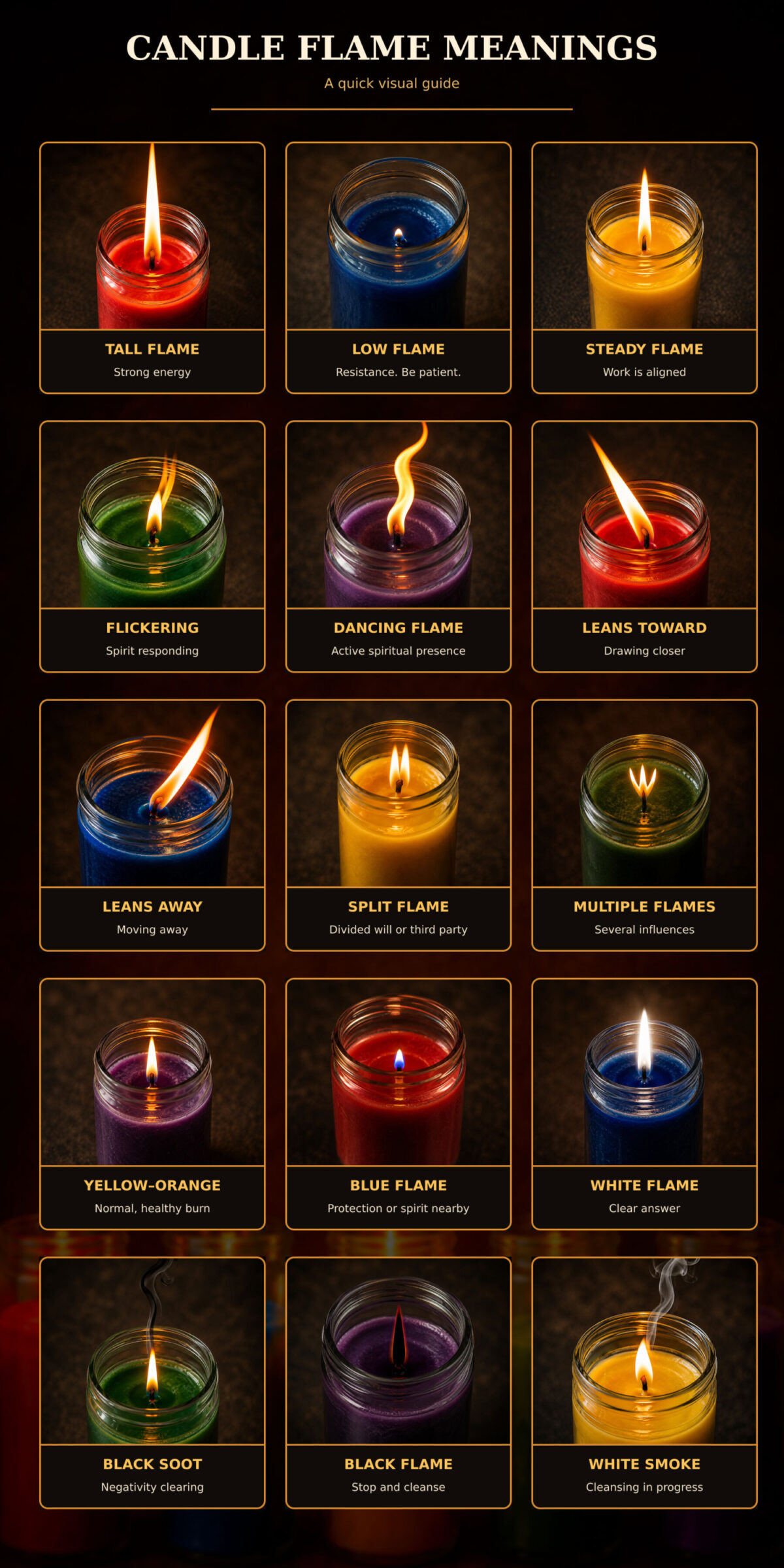
A tall, high flame is usually read as a good sign. It suggests strong energy moving quickly toward your intention, sometimes almost too quickly. If your flame burns unusually tall and bright throughout, many practitioners read this as your petition being received with real force, especially in candles lit for protection or for opening a blocked path.
A low or small flame is not automatically bad, but it does ask for patience. It often points to resistance, whether that is an obstacle in your own situation or simply a working that needs more time to build. Some practitioners read a persistently low flame as a sign to reinforce the work, perhaps with a second candle or a renewed prayer, rather than a sign that the work has failed.
Candle Flame Movement: Flickering, Dancing, and Steady Flames
A steady, still flame is the quiet confirmation every practitioner hopes for. It suggests calm, focus, and energy moving exactly where you intended without resistance. If nothing else about your candle stands out, a flame that simply burns evenly and calmly from start to finish is a sign that your prayer landed the way you meant it to.
A flickering flame is read differently depending on how persistent it is. The occasional flicker, especially early in the burn, is often read as spirit or energy responding to your words, almost like a nod. A flame that flickers constantly and never settles can point to conflict or unresolved tension around your intention, sometimes from another person, sometimes from doubt within yourself.
A dancing or jumping flame goes a step further than flickering. This kind of movement is frequently read as active spiritual presence, energy that is aware of you and responding directly rather than sitting passively. In protection or communication workings, a flame that seems to jump toward you or away from you is worth paying close attention to.
The height of a dancing flame changes what it means. A dancing flame that also burns tall and bright is often read as success arriving with an unexpected twist, while a dancing flame that stays low or weak suggests that same restless energy is more likely to bring complications along the way.
Candle Flame Direction: What a Leaning Flame Means
A flame that leans consistently to one side, even with no draft to explain it, is read by many practitioners as movement, either toward or away from your goal depending on the working. A flame leaning toward you during a drawing or attraction working is often read as a good sign, that what you are calling toward yourself is on its way.
A flame leaning away from you, particularly in a banishing or separation working, can be read as confirmation that whatever you are pushing out is in fact leaving. Context always matters more than the direction alone. The same lean means something different in a love working than it does in a cleansing.
Some practitioners read direction by compass point instead of by where they are standing. If you know which way your candle faces, a flicker toward the north is often read as touching an ordinary, worldly matter rather than a spiritual one. A flicker to the east points to the mental side of your situation resolving in your favor, a flicker to the south points to physical strength behind the work, and to a flicker to the west points to emotional energy being the strongest force at play.
What It Means When a Candle Flame Splits in Two
A flame that splits into two is one of the more striking signs a candle can give, and it tends to draw attention immediately. In many traditions, a double flame points to a third party involved in the situation, someone influencing your circumstances who was not named directly in your working. It can also point to a divided will, part of you pulling one direction and part pulling another.
Three or more flames are rarer still and are usually read as a strong amplification of whatever the double flame would mean, sometimes interpreted as multiple outside influences or an especially complicated situation. A split flame is not a sign to panic over. It is a sign to look more closely at who and what surrounds your intention.
Candle Flame Colors and What They Mean
A word of caution before this section: this is about the color the flame itself burns while it is lit, which is different from the color of the candle or its wax. If you are trying to choose a candle color for a working rather than interpret a flame you are already watching, our Candle Color Meanings guide covers that separately.
Most candle flames burn a standard yellow-orange, and that is simply a neutral, healthy burn. A few unusual colors are worth knowing:
A blue-tinted flame is often read as a sign of spiritual protection or the presence of a strong, watchful energy nearby. Some practitioners associate it specifically with the involvement of a spirit guide or ancestor.
Black soot rising from an otherwise normal flame, rather than the flame itself turning black, usually points to negativity being burned off or released. This is common in cleansing and uncrossing work and is generally read as the candle doing exactly what it was lit to do.
A flame that burns purely white, rather than the usual yellow-orange, is sometimes read as a sign of clarity, or a clean and uncomplicated answer to your petition. A flame that genuinely appears black itself, not simply producing dark soot above it, is rare and unsettling to witness. Many practitioners treat this as a serious warning to stop the working and cleanse the space right away, rather than a sign to interpret further.
Candle Burning Fast, Slow, or Unevenly: What It Means
A candle that burns unusually fast is often read as urgency, either urgency in the situation itself or urgency in how quickly the energy is moving. A candle that burns slowly and evenly points to steady, long-term progress rather than a quick resolution.
Uneven burning, where wax pools heavily on one side or the flame seems to favor one edge of the wick, is frequently read the same way as an uneven flame, meaning there is likely some kind of imbalance or resistance in the situation that the working has not fully cleared yet.
A candle burning at both ends, most often seen with two-wick or reversible candles, is generally read as an intense working with energy moving quickly in two directions at once. This shows up often in return-to-sender or reversing work, where energy is meant to travel back toward its source.
What It Means When a Candle Won't Stay Lit or Goes Out
A candle that refuses to light at all, even after several attempts with a fresh match, is read as a more serious sign than one that lights and later goes out. Many practitioners take this as a signal to stop, cleanse the space and yourself, and reconsider the working entirely before trying again, rather than pushing through with the same candle.
A candle that struggles to stay lit, going out repeatedly no matter how many times you relight it, is one of the signs practitioners take most seriously. It often points to strong resistance, whether spiritual, emotional, or circumstantial, and many will pause the working, cleanse the space, and try again rather than force a candle that keeps refusing to burn.
A candle that goes out on its own after burning normally for a while is read differently depending on how far along the burn was. If it happened near the very end, many practitioners consider the working essentially complete and read it as a natural close rather than a bad sign.
If a candle ever cracks its glass, flares unusually high, or catches something nearby on fire, treat it first as a real fire safety concern and put it out immediately. Only once everything is safe do some practitioners read the event itself, often as a sign of a serious attack, either directed at you or reflecting back after being sent toward someone who was already protected.
Candle Flame Crackling, Popping, and Smoke: What They Mean
A candle that crackles or pops as it burns is sometimes read as spirit communication, almost like a response breaking through, particularly in workings meant to open communication with a guide or ancestor. It is far less common than the visual signs above, so when it happens, many practitioners take it as a signal worth noting.
Smoke has its own reading, sometimes called capnomancy. White smoke rising cleanly from the flame is generally read as a good sign, often taken to mean your prayer or petition has been heard. Heavy, persistent black smoke is read differently depending on the work. In cleansing or uncrossing rituals, it is usually a sign the candle is doing exactly what it was lit to do, burning off negativity. In other kinds of workings, dense black smoke more often points to an obstacle or opposition working against you. A small amount of smoke at the very start or end of a burn is normal either way and not usually significant on its own.
The direction smoke drifts is worth watching too. In a drawing or attraction working, smoke drifting toward you is often read as a good sign, meaning what you are calling in is on its way. In a working meant to send something outward, whether that is healing sent to someone else or negativity you are pushing away, smoke drifting away from you is the sign you want to see, while smoke that lingers or drifts back toward you can mean the energy has not fully left.
Reading Two Candles Burned Side by Side
Some workings call for two candles lit together rather than one, most often in reconciliation work between two people or in workings meant to weigh one outcome against another. In these cases, the candles are read against each other rather than alone.
The candle that burns faster, brighter, or more steadily is often read as the stronger or more willing party in the working. If one candle consistently outpaces the other, some practitioners take that as a sign of where the imbalance lies between the two people or forces involved. If both candles burn down evenly together, it is generally read as a good sign of balance and shared will.
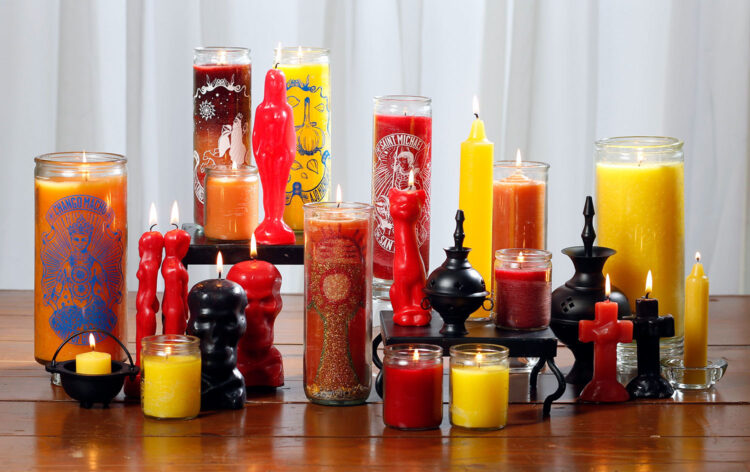
Get 20% Off Your First Candle Order!
For a limited time, use coupon code CANSUM24 and receive 20% off of your first order of any of our spiritual candle products! Offer only good for new customers (excludes wholesale). Don't wait! This offer expires soon!
Sometimes it helps to see these signs rather than only read about them. Watching a flame respond in real time, the flicker, the lean, the sudden dance, makes these interpretations click in a way that description alone cannot always manage.
What Reading Candle Signs Really Teaches You
Read a hundred candles and you start to notice something. The flame does not tell you what to do next. It tells you where you already stand.
That is the deeper lesson underneath all of this. Learning to read a candle is really learning to pay closer attention, to your surroundings, to your intention, and to the small shifts that happen when energy moves. It is a practice of patience dressed up as a practice of fire.
You do not need a working underway to build this skill. Light a small candle on an ordinary evening, one with no petition attached to it at all, and simply watch it for a few minutes without expecting anything. Notice how it moves when you are calm versus when you are not. Over time, you will find you read your ritual candles more clearly, not because the signs changed, but because you did.
Frequently Asked Questions
What does it mean when a candle flame is very tall?
A tall, strong flame is generally read as a good sign, suggesting your intention is being received with real energy. It is especially encouraging in candles lit for protection or for clearing a blocked path.
What does it mean when a candle flame won't stop flickering?
Occasional flickering is often read as a response or acknowledgment. Constant, unrelenting flickering more often points to tension or resistance somewhere around the situation you are working on.
What does it mean when a candle flame splits into two?
A split flame is commonly read as a sign of a third party involved in the situation, or a divided will within yourself. It calls for a closer look at who and what surrounds your intention rather than alarm.
What does it mean when a candle flame leans to one side?
Direction is read in context. A flame leaning toward you in a drawing working is often a good sign, while a flame leaning away during a banishing working can confirm that something is in fact leaving.
What does it mean when a candle goes out on its own?
If it happens near the end of a normal burn, many practitioners read this as the working reaching a natural close. If it happens early and repeatedly, it more often points to resistance that needs to be addressed before continuing.
What does a blue candle flame mean?
A blue-tinted flame is frequently associated with protection or the presence of a watchful spiritual energy, sometimes read as an ancestor or guide making their presence known.
Is it bad if my candle burns unevenly?
Not necessarily bad, but worth noting. Uneven burning is usually read as a sign of some remaining imbalance or resistance in the situation, similar to how an uneven or leaning flame is interpreted.
Your candle's flame is only one part of the story. Once it finishes burning, the wax and the glass it leaves behind carry their own signs, a practice called ceromancy that is a reading in itself worth learning.
A candle burns down to nothing, and somehow it leaves you with more than you started with. That has always been the quiet magic in it. You did not need the flame to shout for you to hear it. You only needed to watch.